
LSA vs Google Ads: Which Drives More Contractor Leads
LSA vs Google Ads: Which Drives More Contractor Leads
LSA Vs Google Ads - Which Drives More Contractor Leads
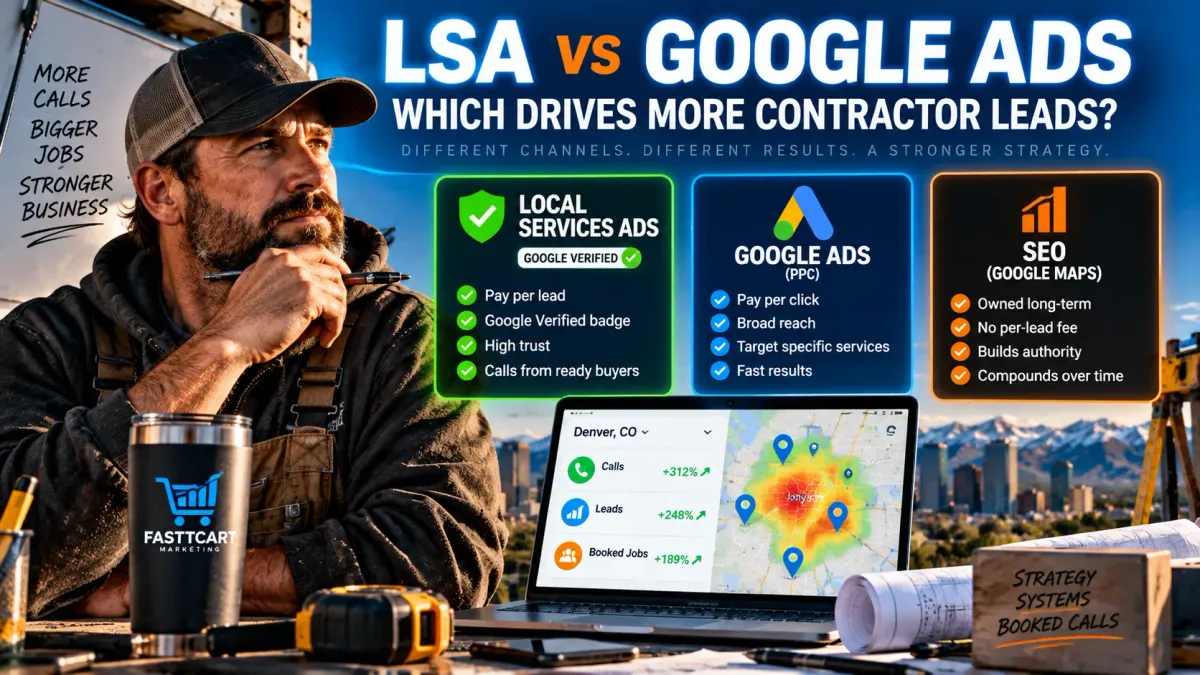
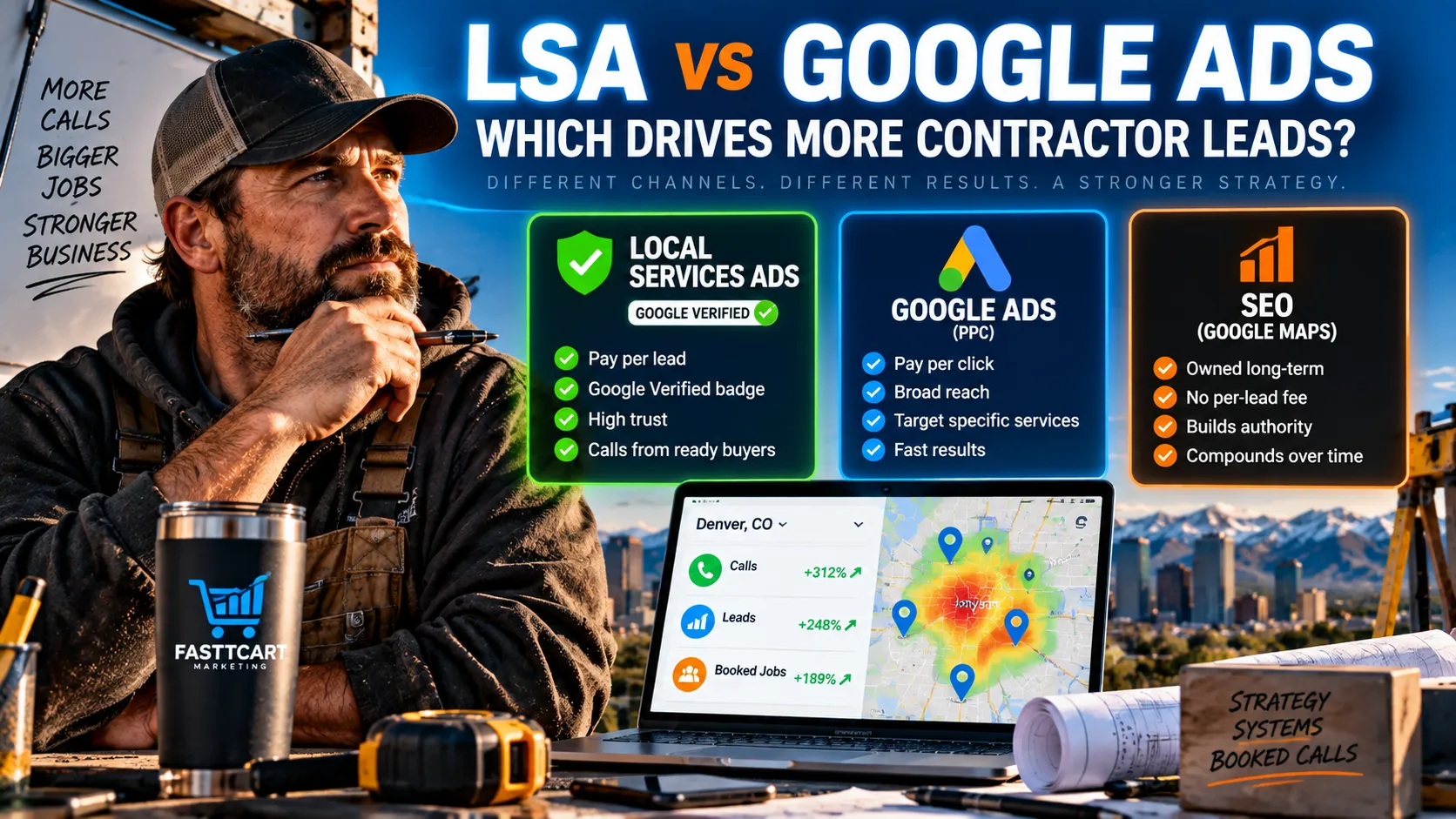
Comparing local services ads vs Google Ads comes down to how you pay and how much trust you get upfront. Local Services Ads charge per lead, not per booked customer, and carry Google's Verified badge for instant trust. Google Ads run on pay-per-click bidding for broad reach. Weighing Google Ads vs SEO for contractors matters just as much: SEO builds long-term Google Maps 3-pack rankings without per-lead fees. We combine all three so contractors stop renting leads from shared portals like Angi and start owning their pipeline.
Key Takeaways
Local Services Ads use pay-per-lead pricing, charging only when customers contact your business directly.
Google Ads operates on pay-per-click model, requiring payment each time someone clicks your advertisement.
Local Services Ads displays the Google Verified badge, building customer trust and confidence in your contracting business.
Combining Local Services Ads with SEO strategies maximizes visibility across multiple search result positions simultaneously.
Fasttcart's content engine acts as a contractor's Digital Memory, a centralized source of truth that keeps business knowledge, messaging, and rankings consistent across every channel.
What's Actually Different Between LSAs, PPC, and SEO?
Three channels get lumped together as "online marketing," and that's the mistake. Contractor lead generation channels don't behave the same way, don't cost the same way, and don't earn trust the same way. Treating them as interchangeable is how contractors burn budget waiting on results that were never coming from that channel in the first place.
We built our business by serving customers, solving problems, and delivering real work. Not by chasing whatever ad platform happened to be trendy that month. That's the lens we use when we sort these three out for a contractor. Google Ads and Local Services Ads offer distinct benefits, not identical outcomes, and neither one replaces solid organic search rankings.
Is LSA vs Google Ads just two flavors of the same ad?
No. Both show up on the search results page, but they work in completely different ways. Standard Google Ads runs on a pay-per-click model targeting keywords across a broad audience. Local services ads contractors rely on show up with a Google-verified badge and reviews. The contractor pays per lead, not per click.
Which channel builds something a contractor still owns five years from now?
Only SEO does that. Paid channels stop producing the moment the budget stops. Organic rankings compound over time and keep generating calls without a per-click or per-lead bill attached.
Here's the quick breakdown:
Fasttcart, based in Denver, Colorado, built the Revenue Revival System to turn whichever channel a contractor invests in into booked technician calls, not just clicks or leads sitting unanswered. We run this system for home service businesses across Denver, Aurora, Lakewood, Littleton, Centennial, Fort Collins, and Colorado Springs, so the comparison below reflects what actually moves the phone in those markets, not generic advice.
How Do Local Services Ads Work For Contractors?
Google local services ads for trade contractors bill differently than standard search ads: Google charges a fee only when a real homeowner calls or messages through the listing, not for every click on the ad. That single mechanic changes the math for a plumbing, HVAC, roofing, or electrical outfit trying to stretch a marketing budget. Compare that to a channel where curious clickers who never book a job still cost money, and the appeal becomes obvious.
Contractors weighing lsa vs google ads need to understand what separates the two beyond price structure. Local Services Ads listings carry a Google Verified badge, a visual signal that tells a homeowner the business passed background and license checks before the phone ever rings. That badge does work standard search ads can't. It builds trust in the three seconds before someone decides whether to call a stranger to fix their furnace.
Getting an LSA listing to actually show up, though, depends on groundwork most contractors skip. We build that groundwork through our GBP Management service, which strengthens the Google Business Profile signals LSA eligibility and ranking rely on. Our Reputation Accelerator System keeps fresh reviews coming in. A thin review count sinks a listing's position in the local pack fast. Once jobs start booking, our Referral Growth System turns those customers into repeat work and referrals, cutting long-term reliance on paid-per-lead traffic.
Do Local Services Ads replace other contractor lead generation channels?
No. Local Services Ads work best as one piece of a broader mix of contractor lead generation channels, not a standalone fix. Pairing them with organic visibility and referral systems protects a business when ad costs climb or lead volume dips.
Where Does Google Ads (PPC) Fit In?
Google Ads earns its place in contractor lead generation channels as the fast lane: pay-per-click search ads and Local Services Ads both put a contractor's phone number in front of homeowners within days, not months. Speed comes at a cost, and that cost never stops as long as the campaign runs.
Competitive metro markets make that cost brutal. A single click on a standard PPC search ad in a tight home service market costs money either way. That's not a lead. That's a click. A homeowner has to actually call and book before that money turns into revenue.
Is Google Ads Better Than Local Services Ads for Contractors?
Neither wins outright. They solve different problems. Standard Google Ads charges per click regardless of outcome. local services ads for contractors charge per lead and carry the Google Guaranteed badge, the Google Guarantee for contractors that builds trust faster with skeptical homeowners. Weighing LSA vs Google Ads comes down to whether we want broad visibility or tighter cost control on qualified calls.
Here's the tradeoff we walk every client through:
Paying for fast calls means nothing if nobody picks up the phone. That's why our 24/7 AI Employee answers every call these campaigns generate, so a shoulder-season lead never lands in voicemail. We run Google Ads Management as its own dedicated service, built to chase booked jobs. Not clicks that never convert.
Why Does SEO Still Matter For Contractors?
Local services ads contractors run tend to draw quick calls, but the calls stop the day the budget stops. Organic rankings work differently. Once a contractor's site and Google Business Profile earn a foothold in the map pack, those rankings keep sending calls at a fraction of what paid channels cost, though it takes time to get there. That's the real math contractors need to run before picking a lane among the available contractor lead generation channels.
We built our SEO And Marketing service around that math. The goal isn't a temporary bump. It's Google Maps 3-pack visibility that holds its position long after the invoice clears. Rankings built right don't need a monthly ad spend to survive.
How long does it take for contractor SEO to start working?
Call volume from organic rankings builds gradually as those rankings mature. The timeline depends on market competition and how neglected the site was beforehand. That's the core tradeoff in local SEO vs PPC for contractors: paid channels like lsa vs google ads turn on faster, but the payoff from SEO compounds instead of resetting to zero each month.
Behind that ranking work sits our V12 Authority Engine, which builds the domain and content signals search engines expect from a business worth trusting with page-one placement. We pair that with what we call the GHC Method, a system built so AI assistants pull contractor businesses into their answers directly, not just traditional blue-link results.
Does SEO replace paid ads entirely?
No. Paid channels fill the gap while organic rankings mature. Once rankings take hold, ad spend becomes optional instead of mandatory.
Which Channel Mix Should Contractors Choose First?

Fasttcart builds channel mixes around schedule gaps and cash flow, not around crowning one platform the winner. Filling shoulder-season gaps and eliminating reliance on shared lead portals like Angi are the two problems this whole comparison exists to solve. A plumbing or HVAC company sitting on empty appointment slots this week needs calls now, not a six-month plan. Waiting for a slow-building strategy while the crew sits idle costs real payroll dollars every day.
The comparison of LSA vs Google Ads isn't a competition. Running both together maximizes visibility and lead volume more than betting everything on one platform. Local Services Ads put a Google-verified badge and reviews in front of homeowners searching right now. Standard Google Ads campaigns reach a wider net of searchers earlier in their decision. Together, these two contractor lead generation channels cover both the ready-to-book customer and the one still comparing options.
Should a contractor pick LSA or Google Ads first?
Neither answer is universal. The real question is which channel a contractor's current schedule and budget need right now. Whether there's runway to invest in something slower-building alongside it. Local services ads for contractors tend to fit shoulder-season gaps fastest because homeowners see verified reviews before they ever click.
Fasttcart's founder spent three decades working Metro Denver's construction and HVAC trades before building channel strategy for contractors. That's not a marketing credential, it's a background that means we know what a slow Tuesday in February costs a four-truck HVAC outfit, and we sequence LSA, PPC, and organic search around that reality instead of a generic playbook. Every strategy runs through what we call a content engine. A centralized source of truth for business knowledge that keeps messaging consistent across every channel a contractor runs. That system relies on a proprietary sequence for building authority. Describes the function of the Brand Vault at the core of how we sequence content, reviews, and rankings together. Contractors get a free site audit that shows exactly which channel is leaking booked calls. A free strategy call to map out the right mix before spending another dollar.
FAQ
What is the main difference between LSA vs Google Ads for contractors?
Local Services Ads charge per lead and display a Google Verified badge for trust. Google Ads runs on pay-per-click bidding for broader reach across search results.
Does SEO replace the need for paid ads like LSA or Google Ads?
No, SEO builds owned Google Maps 3-pack rankings without per-lead fees. It works best combined with LSA and Google Ads rather than replacing them entirely.
Why does Fasttcart combine Local Services Ads, Google Ads, and SEO?
Fasttcart, based in Denver, Colorado, combines all three channels through its Revenue Revival System. Contractors stop renting leads from shared portals and start owning their pipeline.
Conclusion
The choice between Local Services Ads, Google Ads, and SEO isn't binary. It's strategic. Each channel fills a distinct role in your marketing funnel: LSAs capture immediate intent, Google Ads accelerate visibility during shoulder seasons, and SEO builds long-term market dominance. The contractors winning market share aren't choosing one. They're layering all three to control their local landscape and eliminate dependence on shared lead portals. Your budget, service area, and current call volume determine the right mix for your operation.
